
Facelift vs Fillers
Deciding between a facelift and fillers isn't always straightforward, and that's completely understandable. Both options promise a more youthful appearance, but they work in fundamentally different ways and suit different needs. Fillers are injectable treatments that add volume, soften lines, and refresh your look with minimal downtime. A facelift is a surgical procedure that repositions and tightens the underlying tissues of the face for longer-lasting, more dramatic results. The choice depends on factors like your age, the degree of sagging or volume loss you're experiencing, your lifestyle, and honestly, what outcome you're hoping for. Neither option is universally better. One might be perfect for someone in their forties noticing early changes, while the other makes more sense for someone dealing with significant skin laxity. Understanding the real differences between a facelift and fillers helps you have a much more informed conversation with your surgeon.
What Is Facelift vs Fillers?
As faces change with age — deeper lines, sagging skin, lost volume — two options come up more than any other: facelifts and fillers. They're both popular, both effective, but they work in completely different ways and solve different problems.
A facelift is a surgical procedure. A plastic surgeon physically lifts and repositions the underlying tissues of the face, removes excess skin, and tightens everything back into a more youthful position. It's a significant commitment. There's downtime, recovery, and the involvement of anaesthesia. But the results are long-lasting and can address changes that no cream or injection can touch.
Fillers are something else entirely. These are injectable treatments, most commonly made from hyaluronic acid, that add volume beneath the skin. They plump sunken cheeks, soften lines around the mouth, and restore the fullness that naturally fades over time. Treatment takes minutes, there's little to no recovery, and you walk out looking refreshed the same day.
So why compare them? Because patients often face a genuine choice between the two — or a combination of both. Someone with significant skin laxity might wonder if fillers can do what a facelift would. Someone considering surgery might not realise fillers could hold off that decision for years.
The honest answer is that they're not direct substitutes. They complement each other. Understanding what each one actually does — and what it can't do — is the starting point for making a decision that's right for your face and your life.
Key Benefits of Facelift vs Fillers
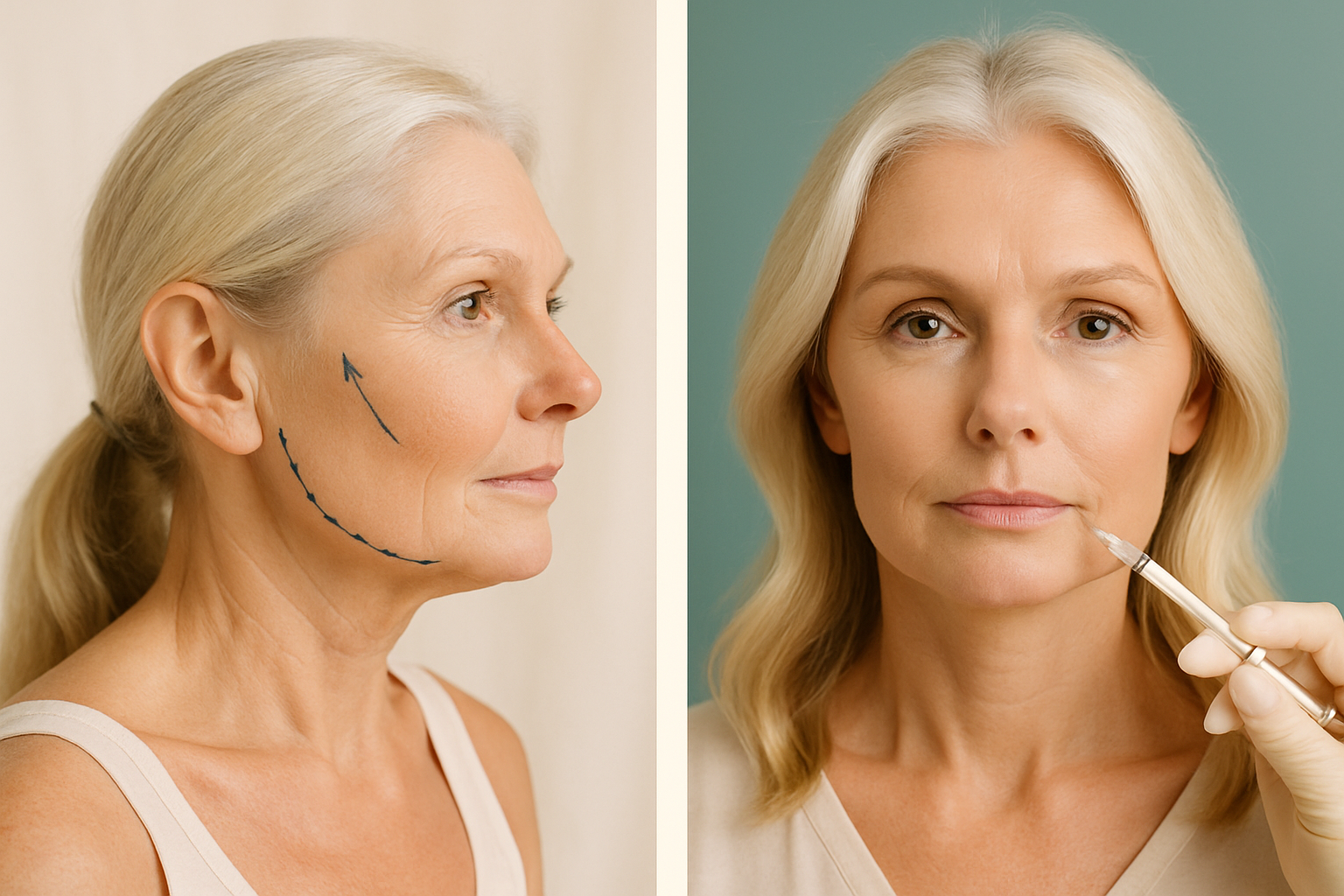
Choosing between a facelift and fillers isn't just about budget or recovery time. It's about understanding what each option can actually do for your face and how long those results will last.
Fillers offer something genuinely valuable: immediacy. You walk in, spend 30–60 minutes in a chair, and walk out looking refreshed. There's no downtime worth speaking of, no surgery, and no permanent commitment. For adding volume to hollow cheeks, softening fine lines around the mouth, or restoring a little fullness to the lips, fillers are hard to beat. They're also reversible in most cases, which gives a lot of people peace of mind. Results typically last anywhere from 6 to 18 months depending on the product used and where it's placed.
A facelift addresses something fillers simply cannot — the underlying structural changes that happen as we age. Loose skin, dropped jowls, and deep sagging along the neck and jawline respond to surgery in a way no injectable can replicate. A well-performed facelift repositions tissue, tightens muscle, and removes excess skin. The results don't just look better; they look natural and they last. Most patients enjoy their outcomes for 10 years or more.
Fillers are brilliant for early-stage ageing concerns, particularly in your 30s and 40s. But there comes a point where adding more volume to a face that has already lost structural support can start to look heavy or overfilled. That's often when a facelift becomes the more sensible — and more flattering — choice.
Neither option is universally superior. The right answer depends entirely on your anatomy, your goals, and where you are in the ageing process. A good consultation will make that clear quickly.
How Facelift vs Fillers Works

These two treatments take completely different routes to refresh your appearance. Understanding the mechanics helps you know what you're actually signing up for.
How a Facelift Works
A facelift is a surgical procedure performed under anaesthesia. Your surgeon makes discreet incisions, typically along the hairline and around the ears. From there, they lift and reposition the underlying facial muscles and connective tissue — a layer called the SMAS. Excess skin is trimmed away, and the remaining skin is re-draped smoothly over your newly repositioned facial structure. The incisions are then closed with fine sutures. Recovery takes a few weeks, but the results address genuine structural changes like deep jowls, a loose neck, and significant skin laxity. It's a proper reset.
How Fillers Work
Fillers are injectable treatments, most commonly made from hyaluronic acid, a substance your body already produces naturally. Using a fine needle or cannula, a practitioner places small amounts of gel beneath the skin in targeted areas — cheeks, lips, nasolabial folds, temples. The filler adds volume, softens hollows, and can subtly lift certain areas by restoring lost structure. The whole appointment usually takes under an hour. There's no cutting, no anaesthesia, and most people return to their day almost immediately.
The Core Difference in Mechanism
A facelift physically repositions and removes tissue. Fillers add volume to compensate for what's been lost. That distinction matters enormously in terms of results. Fillers work beautifully for early volume loss and fine lines, but they can't tighten loose skin or redefine a sagging jawline the way surgery can. Equally, a facelift won't restore the plumpness that fillers provide.
Neither is universally better. They solve different problems, and sometimes they work best together.
Common Questions About Facelift vs Fillers
Which lasts longer, a facelift or fillers? A facelift typically lasts 7–10 years, sometimes longer. Fillers are temporary — most last anywhere from 6 months to 2 years depending on the product used and where it's placed. If you want results you don't have to maintain regularly, surgery is the more durable choice.
Am I too young for a facelift? Most facelift patients are in their 40s to 60s, but age alone isn't the deciding factor. Skin laxity, bone structure, and overall health matter more than the number on your birth certificate. Fillers are often a better starting point for younger patients dealing with early volume loss.
Can fillers replace a facelift entirely? For mild to moderate concerns, yes — fillers can do impressive work. But they can't tighten loose skin or reposition deeper facial tissues. At a certain point, adding more filler without surgery can actually make the face look heavier rather than refreshed.
Is one option safer than the other? Both carry risks, but they're very different in nature. Filler complications are usually minor and reversible. Surgical risks are more significant but rare when performed by a qualified surgeon. Neither is inherently "safer" — it depends on your health, your provider's skill, and realistic expectations.
What if I want to start with fillers and consider surgery later? That's a completely reasonable approach. Many people use fillers to preview results or simply delay surgery. The two aren't mutually exclusive, and a good surgeon will never pressure you toward the operating room before you're ready.
Conclusion
Choosing between a facelift and fillers isn't about picking the "better" option. It's about finding the right fit for your face, your goals, and your life right now.
Fillers work beautifully for early volume loss and subtle refreshing. They're quick, reversible, and easy to fit around a busy schedule. A facelift addresses deeper structural changes that no injectable can replicate. The results last longer and the transformation runs deeper.
A few things to remember:
- Fillers suit mild to moderate concerns
- Facelifts deliver lasting change for significant sagging or loose skin
- Age matters less than the condition of your skin and what you want to achieve
The clearest next step? Book a consultation with a qualified, experienced surgeon. Bring your questions, be honest about your goals, and let them guide you toward the option that genuinely serves you best.